
There Is No Such Thing as a "Women's Paddle"
Hey pickleball pals! Let us start with the least commercial thing we will say all year: paddles are not gendered equipment. There is no women's core, no women's carbon weave, and nothing inside a paddle that knows or cares who is holding it.
What is true is that the specs which matter most to comfort and control, grip circumference and weight, tend to sit at different points for players with smaller hands and shorter levers. That is not a marketing category. It is just fit, the same way running shoes are.
So this guide is not a list of paddles with flowers on them. It is the four numbers to check, how to work out your own, and an honest note about where ours lands.
The Only Four Specs That Change How a Paddle Feels
1. Grip circumference, the one people get wrong
This is the single most common mistake, and it causes more elbow and wrist trouble than any other spec. A grip too large forces you to squeeze harder to keep the paddle from twisting on off-centre hits. Squeezing harder for two hours is how sore forearms happen.
To find yours, measure from the middle crease of your palm to the tip of your ring finger, in inches. That number is roughly your ideal grip circumference. Most adults land between 4 and 4.5 inches, and a lot of women land near 4 to 4.25.
Err small if you are between sizes. You can always add an overgrip to build a handle up. You cannot shave one down.
2. Weight, which is a tradeoff and not a ranking
Lighter paddles, under about 7.8 oz, move faster at the net and are kinder to the arm. Heavier ones, above about 8.4 oz, give you more put-away power without swinging harder, but they are slower in fast hands battles and less forgiving over a long day.
Most players are happiest somewhere in the middle, around 7.9 to 8.3 oz. Nobody needs to be at an extreme, and being at one is not a sign of skill.
3. Shape, which decides reach versus forgiveness
A standard shape, around 16 inches long, has a wider face and a bigger sweet spot. It is the more forgiving choice and a genuinely good one.
An elongated shape, around 16.5 inches, trades a little of that width for reach and leverage. It suits players who like a two-handed backhand, because the extra handle length gives the second hand somewhere to go.
4. Core and face, where the money goes
Thicker cores, 14 to 16 mm, absorb more and control better. Thinner cores are poppier and less forgiving. Foam cores hold on to the ball fractionally longer, which shows up as control on dinks and resets. We went through this properly in Foam Core Paddles: What the Hype Actually Means if you want the long version.
Carbon faces grip the ball and help spin. Fiberglass is livelier. Many paddles, ours included, use both to get some of each. If you care about spin specifically, the rules changed recently and we covered that in The New Spin Test.
How to Actually Choose
Measure your hand first. Get the grip right and everything else is preference rather than pain.
Then pick the tradeoff you care about. If your hands feel slow at the net, go lighter. If you feel like you are muscling every put-away, go heavier. If you play a two-handed backhand, look elongated. If you shank a lot of balls off the edge, stay standard and enjoy the bigger sweet spot.
If you would rather see everything side by side, the full range is here, and the bundles work out cheaper if you need balls and socks too.
Ignore anything that sounds like a physics claim without a number attached. If a paddle promises more spin, ask how many millimetres thick the core is and what the face is made of. Specs are checkable. Adjectives are not.
Where Our Paddle Lands, Honestly
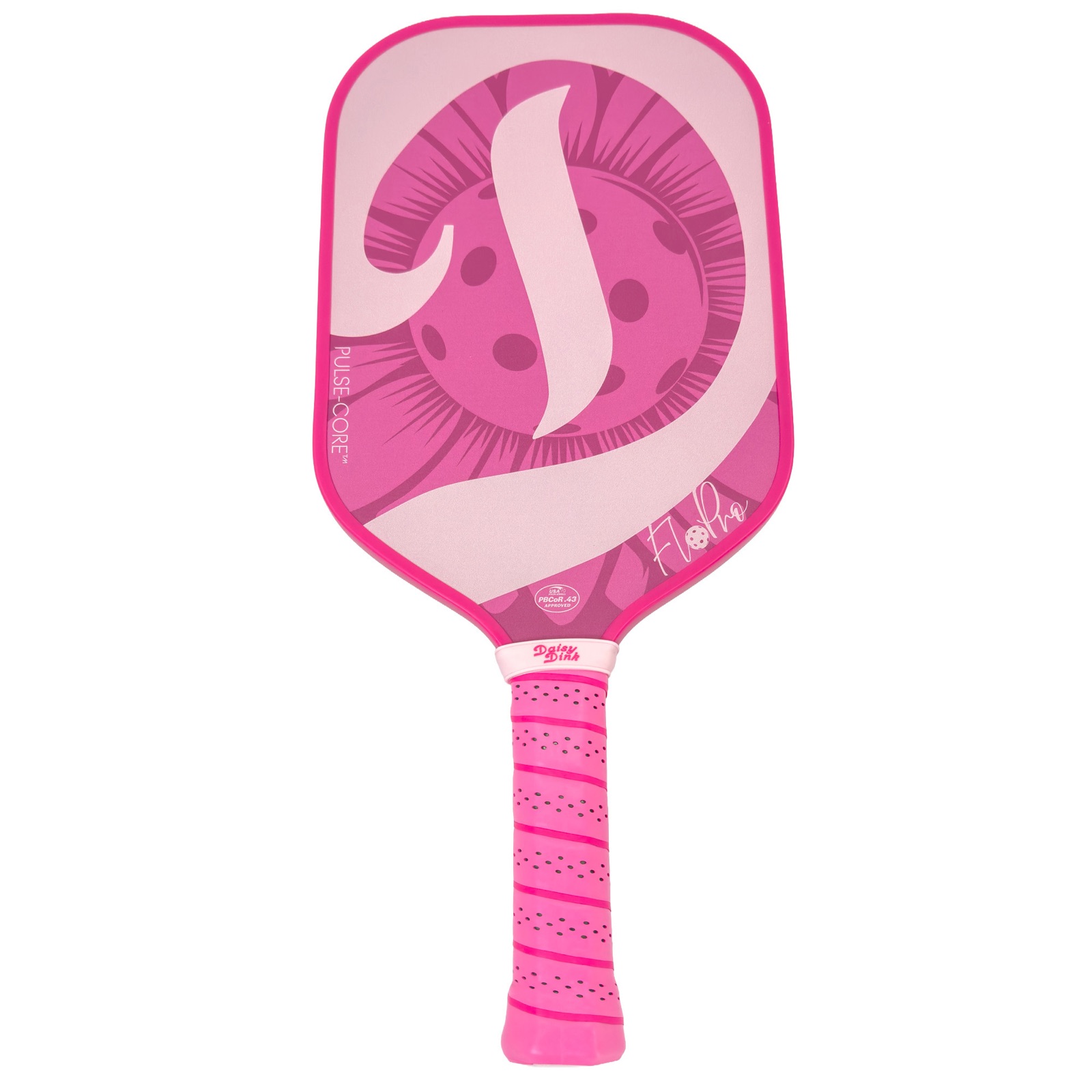
The Daisy Dink FloPro Pulse-Core Pro Paddle is $119.99, and here are its numbers rather than its adjectives:
- Handle circumference 4.25 in. Small-to-standard. If your palm-to-ring-finger measurement is around 4 to 4.4 inches, this fits without an overgrip.
- Weight 8.2 oz. Mid-weight. Enough mass to put a ball away, still quick in hands battles.
- 16.5 in elongated, 5.5 in grip. Built for reach and for two-handed backhands.
- 14 mm full-foam perforated core. On the control end, which is where most of the game is played.
- 5 carbon layers plus 1 fiberglass. Carbon for bite on the ball, fiberglass for a bit of life.
- An RFID chip in the handle, so the paddle can be identified as genuine.
- It comes with a paddle eraser, because a carbon face only grips while it is clean.
Who it is not for: if you want the lightest possible paddle for pure hand speed, 8.2 oz is heavier than you want. If you shank balls off the edge regularly, a standard shape will forgive you more than an elongated one will. We would rather you enjoy playing than own ours.
Two Things Worth More Than a New Paddle
An overgrip costs a few dollars and fixes a handle that is slightly too small. It is the cheapest comfort upgrade in the sport.
And keep the face clean. A carbon surface generates spin through texture, and texture fills up with dust and ball residue faster than people expect. Wiping it between games does more for your spin than most upgrades do.
Play well out there. See you on the courts.
Women-owned, women-focused pickleball. We write about the gear, the game, and the culture. Live bold, play beautifully. 🌸
Keep reading

Join the conversation 🌸
Get The Daily Dink and weigh in every week.