
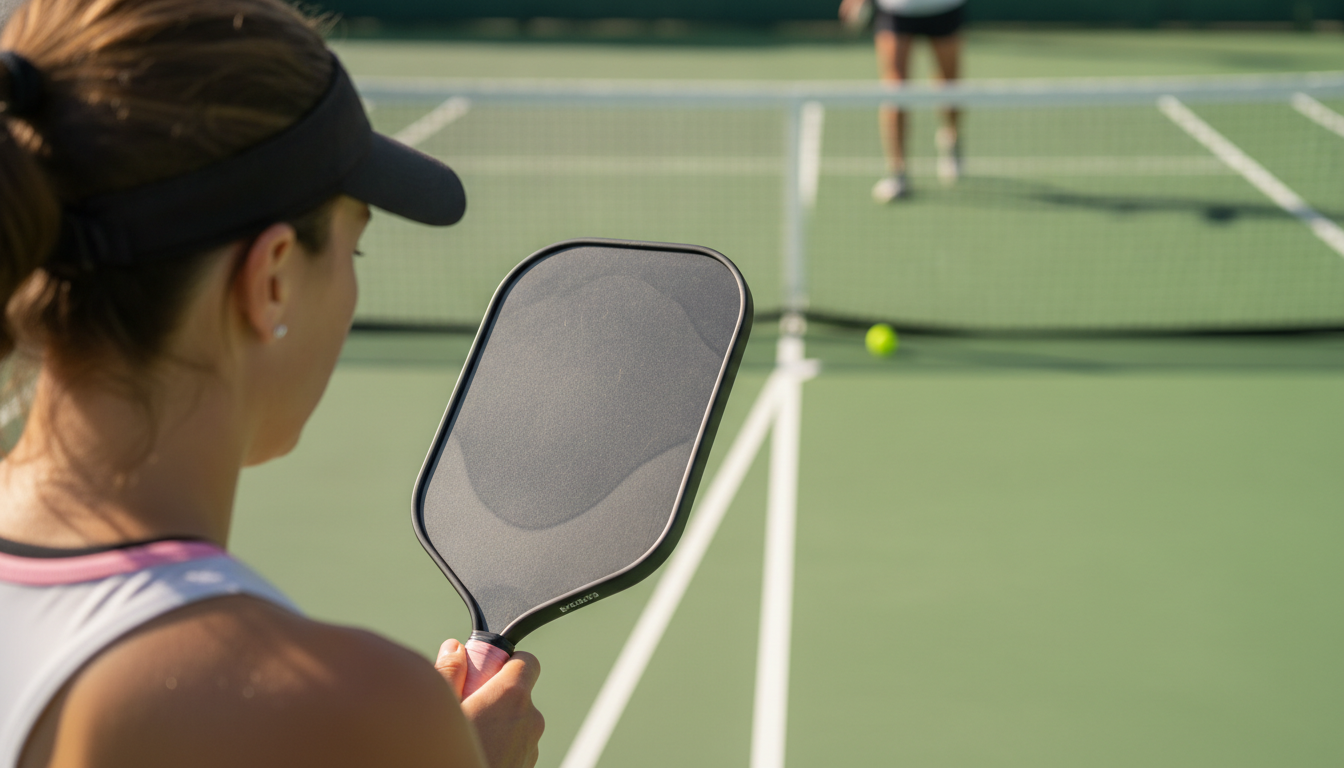
Foam Core, Explained Without the Jargon
Hey pickleball pals! If you have shopped for a paddle lately, you have probably run into the phrase "foam core" about forty times, usually in very large letters, usually right next to a very large price. And unless you happen to moonlight as a materials engineer, it is a little hard to tell whether that is a genuine leap forward or just this season's favorite buzzword.
So let's slow down and actually talk about it. No hype, no scoreboard of brand names. Just what foam does inside a paddle, what it changes when the ball is coming at you, and how to figure out whether it belongs in your bag. By the end you should be able to read any paddle spec sheet and know what you are looking at.
What Is Actually Inside a Paddle
Every paddle is basically three things: a face, a core, and a handle. The face is the material you strike with, usually carbon fiber, fiberglass, or a blend of the two. The handle is the part your grip goes on. The core is the sandwich filling in the middle, and it does far more work than most people realize.
For most of pickleball's history, that core has been a honeycomb: a grid of little hollow cells, usually polypropylene, standing on end between the two faces. Honeycomb is light, it is cheap to make, and it is genuinely good. It has been the default for a long time for solid reasons.
A foam core swaps some or all of that hollow grid for solid foam. Some paddles inject foam only around the perimeter, which is why you will see "foam-injected edge" or "perimeter foam" on a spec sheet. Others fill the whole core, sometimes perforated with channels to keep the weight sane. Same idea either way: put denser material where the hollow cells used to be.
What Foam Actually Changes When You Play
Here is the part that matters, because "denser core material" does not mean much until you are standing at the kitchen line.
- The sweet spot feels bigger. This is the big one. A hollow honeycomb cell near the edge of the paddle flexes more than one near the middle, so off-center hits go soft and unpredictable. Foam resists that twist, so a ball struck an inch off center behaves much more like one struck dead center. The sweet spot has not literally grown, but the usable area has, and that is what you feel.
- Less buzz in your hand. Foam is very good at eating vibration. If you have ever finished a long session with a faint hum in your forearm, that is the sensation foam is designed to absorb.
- More stability on contact. Blocking a hard drive is a fight between the ball's momentum and your paddle's willingness to stay put. A denser core simply twists less, which means fewer blocks squirting off at an angle you did not choose.
- A softer, quieter feel. Most players describe foam as plusher and less clicky. That is a genuine advantage for touch shots, where you want the ball to sit down rather than spring off.
Foam Is Not Automatically Better
Now the honest part, because a gear guide that only lists upsides is not a gear guide, it is an advertisement.
Foam is heavier than air. Filling a core with it adds mass, and much of that mass sits away from your hand, which raises what players call swing weight. A high swing weight feels powerful and planted on drives, and it feels sluggish in a fast hands battle at the net. If your favorite thing in pickleball is winning frantic exchanges four feet from your opponent, a lighter honeycomb paddle may genuinely suit you better.
Foam also has a lifespan. Solid foam under repeated impact can compress and soften over time, and a paddle that has gone soft loses some of the pop it started with. Honeycomb is not immortal either, but it tends to fail obviously by cracking rather than quietly by going dull.
And foam costs money, which is a real part of why foam-core paddles cluster at the higher end of the price range. If you have been playing for three months and are still deciding whether you like the sport, a mid-priced honeycomb paddle is a completely respectable answer, and anyone who tells you otherwise is selling something.
How to Read a Paddle Spec Sheet
Once you know what the core does, the rest of the numbers get much easier. Here is what to look at and what each one is telling you.
- Thickness, in millimeters. Usually 13, 14, or 16. Thicker generally means more control and a softer feel. Thinner generally means more power and a livelier response. 14 mm is the common middle ground.
- Face material. Carbon fiber grips the ball for spin and gives a connected, precise feel. Fiberglass is livelier and adds pop. Plenty of paddles blend both to get some of each.
- Weight. Under about 7.7 oz is light and quick. Roughly 7.8 to 8.2 oz is the mid-weight range most players land in. Above 8.3 oz trades hand speed for power and stability.
- Shape. An elongated paddle, around 16.5 inches, gives you reach and leverage. A widebody, closer to 16 inches, is shorter but wider, with a more forgiving sweet spot side to side.
- Grip length and circumference. The most ignored spec and one of the most important. A longer grip, 5.5 inches or so, gives room for a two-handed backhand. Circumference should let your fingertips just barely reach your palm. Too small and you will squeeze; too large and you will lose wrist snap.
If a product page will not tell you these five numbers, that is information too.
Where Our Pulse-Core FloPro Lands
We should be upfront: we make a foam-core paddle, so we are not a neutral party here. What we can do is give you the actual numbers so you can judge it the same way you would judge anything else.
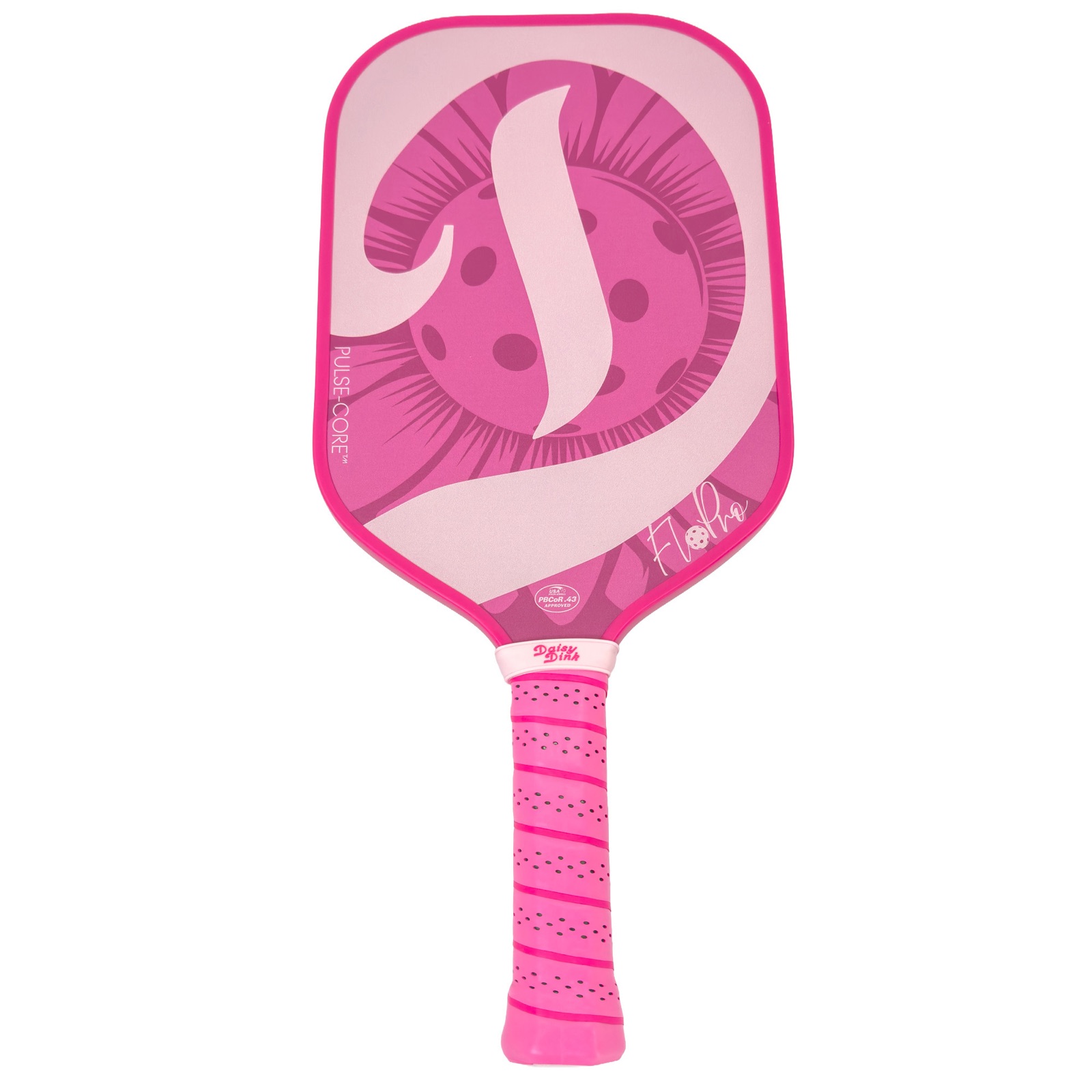
The Daisy Dink FloPro Pulse-Core Pro Paddle uses a full-foam perforated core, not perimeter foam. The perforations are there to keep the weight from running away, which is the tradeoff we talked about above. The face is a hybrid layup, five layers of carbon plus one of fiberglass, aiming for carbon's grip on the ball with a little of fiberglass's liveliness so it does not feel dead on drives.
The specifics, so you can compare them against anything else you are considering:
- Dimensions: 16.5 x 7.44 in, an elongated shape
- Thickness: 14 mm
- Weight: 8.2 oz, give or take 0.18 oz
- Grip: 5.5 in long, 4.25 in circumference
- Face: 5 layers carbon, 1 layer fiberglass
- Core: full-foam, perforated
- Extras: an RFID chip in the handle for authenticity and registration, and a paddle eraser in the box to keep the face texture fresh
- Price: $119.99
Read those numbers honestly and they tell you who it is for. At 8.2 oz with an elongated head, this is a mid-weight paddle with real leverage behind it, and the 5.5 inch grip means a two-handed backhand fits comfortably. That combination suits a player who wants reach and stability and does not mind a paddle with some presence in the hand.
It also tells you who it is not for. If you want the absolute fastest hands at the net, or you are managing an elbow and counting every ounce, a lighter widebody is the more sensible pick, and we would rather you play comfortably than buy from us. The 16.5 inch shape also asks slightly more of your timing than a shorter, wider face does. That is the trade you make for the reach.
Choosing What Actually Fits Your Game
The best paddle is not the one with the newest technology in the biggest letters. It is the one that matches how you actually play, which means the honest first step is to describe your own game to yourself.
Do you win points with patience at the kitchen, or with drives from the baseline? Do you hit a two-handed backhand? Have your hands or elbows complained after long sessions? Are you playing twice a month or five times a week? A player who dinks patiently and plays constantly needs something very different from a weekend power hitter, and neither one is doing it wrong.
Then, if you possibly can, hit with one before you buy. Borrowing a paddle for a few games at open play tells you more in fifteen minutes than any spec sheet will, including ours. Our court finder is a good way to turn up open play near you, and the events page lists what is coming up locally. Pickleball people are famously willing to hand you their paddle for a game if you ask nicely.
The Short Version
Foam core is real technology, not marketing vapor. It expands the usable face of a paddle, calms vibration, and holds steady when you block. It also adds swing weight, costs more, and can soften over the years. Real tool, real tradeoffs, which is the most useful thing anyone can tell you about a piece of gear.
Learn the five numbers, be honest about how you play, and hit with a paddle before you commit to it. Do that and you will make a good decision, whatever ends up in your bag. If you want to see how ours stacks up against your current one, the full spec breakdown lives over in the shop. Now go play.
Women-owned, women-focused pickleball. We write about the gear, the game, and the culture. Live bold, play beautifully. 🌸
Keep reading

Join the conversation 🌸
Get The Daily Dink and weigh in every week.